What is PCA Whitening and Why Use It
PCA whitening is a powerful data preprocessing technique used in machine learning and data analysis to transform data in a way that simplifies further processing. It combines Principal Component Analysis (PCA) with a whitening transformation. The primary goals are to remove correlations between features and to scale the variance of each feature to be equal, typically to 1. This process helps improve the performance of machine learning models by making the data more amenable to algorithms that assume uncorrelated or standardized inputs. Whitening ensures all components contribute equally, which can be particularly beneficial for algorithms sensitive to feature scaling, such as Support Vector Machines (SVMs) and neural networks. It’s often a critical step in preparing data for these kinds of models, especially when the features have varying scales or are highly correlated. By doing so, we aim to make the dataset easier to understand and interpret and boost the effectiveness of the following machine learning processes.
Understanding PCA Whitening
At its core, PCA whitening involves two main steps. First, PCA is applied to reduce the dimensionality of the data and decorrelate the features. PCA identifies the principal components, which are orthogonal directions in the feature space that capture the most variance in the data. After PCA, the data is whitened. Whitening is the process of transforming the PCA-transformed data to have a unit variance for each component. This ensures that all principal components contribute equally to the analysis, preventing any single component from dominating the others. The combination of PCA and whitening ensures both feature decorrelation and equal variance, which are crucial for many machine learning algorithms. This preprocessing step can significantly improve the accuracy and convergence speed of models, especially when the input data is complex and high-dimensional.
Benefits of PCA Whitening

The benefits of PCA whitening are numerous, extending to multiple areas of data analysis and machine learning. First, it improves the performance of algorithms sensitive to feature scaling, such as SVMs and neural networks. It removes the need to carefully tune hyperparameters related to feature scaling. Second, it reduces the impact of multicollinearity (high correlation among features), making models more stable and interpretable. This can lead to better generalization performance on unseen data. Third, it can help with dimensionality reduction, allowing for faster computations and reduced storage requirements. Fourth, whitening can improve the visual representation of data, making it easier to identify patterns and clusters. This is particularly helpful in exploratory data analysis. Overall, the process of whitening data is a versatile tool, significantly enhancing the effectiveness of various machine learning techniques and data analysis workflows.
PCA Whitening in Python Method 1 Standardization
Standardization, a fundamental preprocessing step, is vital to PCA whitening. It involves transforming the data to have a mean of 0 and a standard deviation of 1. This ensures that all features are on the same scale, which is essential for PCA to function correctly. Without standardization, features with larger values would disproportionately influence the principal components. Standardization typically involves subtracting the mean from each data point and dividing by the standard deviation. This centers the data around the origin and ensures that the variance of each feature is scaled to unity. The result is a dataset where all features have an equal opportunity to contribute to the principal components. This preprocessing step often forms the basis for more advanced whitening techniques, offering an initial scale for more complex transformations.
How to Standardize Data
Standardizing data in Python is straightforward, typically done using the scikit-learn library. The StandardScaler class is used to fit the standardization parameters (mean and standard deviation) to the training data and then transform both the training and test data. The process involves importing StandardScaler, creating an instance of it, fitting it to the training data using the fit() method, and then applying the transformation to both the training and test data using the transform() method. This ensures that the same scaling parameters are used for both datasets, preventing data leakage. Standardizing before applying PCA is crucial because PCA is sensitive to the scale of the data. It makes PCA more effective by ensuring each feature contributes equally to the component analysis. Proper standardization leads to more meaningful and reliable results from PCA.
Implementation in Python

Implementing standardization in Python is efficiently managed through scikit-learn. The following Python code snippet illustrates how to apply standardization:
python from sklearn.preprocessing import StandardScaler import numpy as np
data = np.array([[1, 2, 3], [4, 5, 6], [7, 8, 9]])
scaler = StandardScaler() scaled_data = scaler.fit_transform(data)
print(scaled_data)
In this example, StandardScaler is used to standardize the data. This approach is highly effective due to its simplicity and its ability to handle data sets of any size. Always remember to apply the same scaler instance to both your training and test sets. The fit-transform method calculates and applies the standardization to your data.
PCA Whitening in Python Method 2 Eigenvalue Decomposition
Eigenvalue decomposition is a core concept in PCA whitening, enabling the transformation of data into a whitened form. This technique involves breaking down a matrix into its constituent eigenvalues and eigenvectors. In the context of PCA whitening, the covariance matrix of the data is decomposed into its eigenvectors and eigenvalues. The eigenvectors represent the principal components, while the eigenvalues represent the variance along each principal component. This decomposition is crucial for decorrelating the data and ensuring that each feature has a variance of 1 after whitening. Eigenvalue decomposition forms the mathematical backbone of PCA whitening. It provides the means to identify the principal components and transform the data to remove correlations and scale variance appropriately. The use of eigenvalue decomposition forms the basis for methods beyond simple standardization.
Calculating Eigenvalues and Eigenvectors
Calculating eigenvalues and eigenvectors in Python can be done using the NumPy library. NumPy’s linalg.eig() function provides a simple way to perform this calculation. Given a matrix (e.g., the covariance matrix of the data), this function returns the eigenvalues and eigenvectors. The eigenvectors are arranged in columns of a matrix, with each column corresponding to an eigenvalue. These eigenvectors represent the principal components, and the eigenvalues indicate the amount of variance explained by each component. The process involves calculating the covariance matrix, and then using linalg.eig() to decompose it. The resulting eigenvalues and eigenvectors are then used to perform the whitening transformation. This decomposition is fundamental to understanding the underlying structure of the data and is key to effective PCA whitening.
Whitening Transformation using Eigenvalues

The whitening transformation, leveraging eigenvalues, is the core step after PCA. It involves dividing the PCA-transformed data by the square root of the eigenvalues. This scales each principal component by the inverse of its standard deviation, effectively making each component have a variance of 1. The formula for whitening is typically represented as X_whitened = X_pca * diag(1 / sqrt(eigenvalues)), where X_pca is the data after PCA, and diag() creates a diagonal matrix using the eigenvalues. This transformation ensures that all components contribute equally, resulting in decorrelated data with unit variance. This transformation eliminates the variance differences between the principal components. Applying this transformation after obtaining the PCA transformation helps to create a more uniform distribution. This is especially beneficial for algorithms like neural networks that benefit from standardized inputs.
PCA Whitening in Python Method 3 ZCA Whitening
ZCA (Zero-component analysis) whitening is another prevalent whitening technique, standing for Zero-component Analysis. It transforms the data so that its covariance matrix becomes the identity matrix. The method is known for preserving the original structure of the data and providing a visually intuitive transformation. Unlike PCA whitening, ZCA whitening transforms the data in a way that closely resembles the original data. ZCA whitening is often favored for image data because it preserves the structure of the images better than other whitening methods. It transforms the data to have the same variance and is considered a more natural representation. By implementing ZCA, the data is transformed to have the same variance and mean. This is accomplished through mathematical transformations involving the covariance matrix.
Steps for ZCA Whitening
The steps for ZCA whitening include several key operations. First, the data is centered by subtracting the mean. This ensures that the data has a mean of zero. Second, the covariance matrix of the centered data is computed. Third, the eigenvalue decomposition of the covariance matrix is performed to find the eigenvalues and eigenvectors. Fourth, the data is transformed using the eigenvalues and eigenvectors to achieve whitening. This transformation involves multiplying the centered data by the eigenvectors and then multiplying by the inverse square root of the eigenvalues, and finally, multiplying by the transpose of the eigenvectors. This transformation decorrelates the data and scales each component to unit variance, which is the essence of whitening. These steps help in preparing the data for various machine learning algorithms.
ZCA Whitening Code Implementation

Implementing ZCA whitening in Python can be accomplished by leveraging NumPy and linear algebra operations. Here’s a code example:
python import numpy as np
def zca_whitening(X):
Center the data
X_centered = X - np.mean(X, axis=0)
Calculate the covariance matrix
cov = np.cov(X_centered, rowvar=False)
Eigenvalue decomposition
U, S, V = np.linalg.svd(cov)
Whitening transformation
epsilon = 1e-5 # Regularization term ZCA_matrix = U.dot(np.diag(1.0 / np.sqrt(S + epsilon)).dot(U.T)) X_zca = np.dot(X_centered, ZCA_matrix)
return X_zca, ZCA_matrix
Example usage
data = np.array([[1, 2, 3], [4, 5, 6], [7, 8, 9]]) X_zca, ZCA_matrix = zca_whitening(data) print(X_zca)
This code demonstrates how to perform the ZCA whitening process. It involves steps from centering the data to eigenvalue decomposition and the whitening transformation itself. This code can be implemented as a basic foundation for understanding and applying ZCA whitening to various datasets.
PCA Whitening in Python Method 4 Using Scikit-learn
Scikit-learn provides a convenient way to implement PCA whitening. The PCA class in scikit-learn can be used to perform PCA, and the whiten=True parameter can be set to apply whitening automatically. This simplifies the process, making it easy to integrate PCA whitening into your data preprocessing pipeline. This approach is useful for rapidly applying PCA whitening without needing to manually compute eigenvalues and eigenvectors. Using this library significantly reduces the manual effort needed, providing an effective solution for data transformation. This can also be done by importing the PCA class and setting the whiten parameter to True. The integration is easy and fits well with the rest of your scikit-learn workflow.
Implementing PCA and Whitening with Scikit-learn
Implementing PCA whitening with scikit-learn is relatively straightforward. Here’s an example:
python from sklearn.decomposition import PCA import numpy as np
data = np.array([[1, 2, 3], [4, 5, 6], [7, 8, 9]]) pca = PCA(n_components=2, whiten=True)
pca.fit(data) whitened_data = pca.transform(data)
print(whitened_data)
This code snippet demonstrates how to use the PCA class with the whiten=True parameter to perform PCA whitening. First, an instance of PCA is created, with the number of components specified. The model is then fit to the data, and the transform() method is used to apply the PCA whitening transformation. The ease of implementation makes it a popular choice for practitioners. This simplicity facilitates rapid experimentation and integration into larger machine-learning pipelines.
Parameters to consider
When using PCA whitening, there are several parameters to consider. One of the most important is the number of components to retain. This parameter, usually denoted as n_components, determines the dimensionality of the transformed data. The selection of n_components impacts the model’s performance and the amount of variance retained. Another parameter is the regularization term, which is sometimes added to the eigenvalues to prevent division by zero. Regularization helps stabilize the whitening transformation, especially when dealing with noisy data. Careful consideration of these parameters is crucial for optimizing the performance of your machine-learning models. It’s recommended to experiment with different settings to find the optimal configuration for your data.
PCA Whitening in Python Method 5 Practical Examples
PCA whitening finds extensive use in various practical scenarios. It is particularly effective in areas such as image processing and time series analysis. Let’s explore these practical applications and see how PCA whitening can boost data preprocessing.
Image Data Whitening
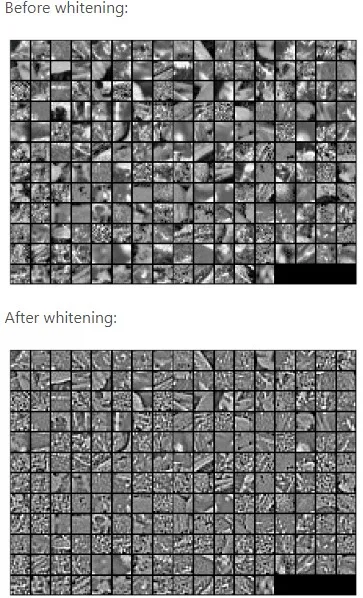
In image processing, PCA whitening is used to remove correlations between image pixels and to normalize the variance of pixel intensities. This can enhance the performance of machine-learning models used for image recognition, object detection, and image classification. It can be done using ZCA whitening because it better preserves the original image structure. For image analysis, each pixel is often considered a feature. Whitening helps to remove any redundancy. This also assists in making the data suitable for downstream tasks, such as image classification, and improving model accuracy. Through this approach, we can improve the overall performance of various image analysis models and techniques. This also helps improve the model accuracy.
Time Series Whitening

PCA whitening is also applicable to time series analysis. By decorrelating time series data and scaling the variance, PCA whitening can improve the accuracy of forecasting models and anomaly detection algorithms. It is especially useful in financial time series data, where the goal is to make the series stationary and remove dependencies. This makes it easier to predict the data behavior. Whitening is used to transform the series and helps to improve the performance of various forecasting models and other time-series analysis methods. The transformation of time series can help in analyzing complex data patterns to gain insight into data behavior.
Conclusion
PCA whitening is a powerful data preprocessing technique that significantly enhances the performance of machine-learning models. It decorrelates features and scales the variance to be equal, which can lead to better model accuracy and faster convergence. Whether you’re working with image data, time series, or other types of data, PCA whitening can be an invaluable tool in your data science toolkit. The methods range from basic standardization to more complex techniques like ZCA whitening. Leveraging these methods effectively can help improve the performance of machine learning models. By understanding and applying PCA whitening, you can improve data analysis and machine learning workflows. Remember to choose the method that best fits your specific data and the goals of your analysis.